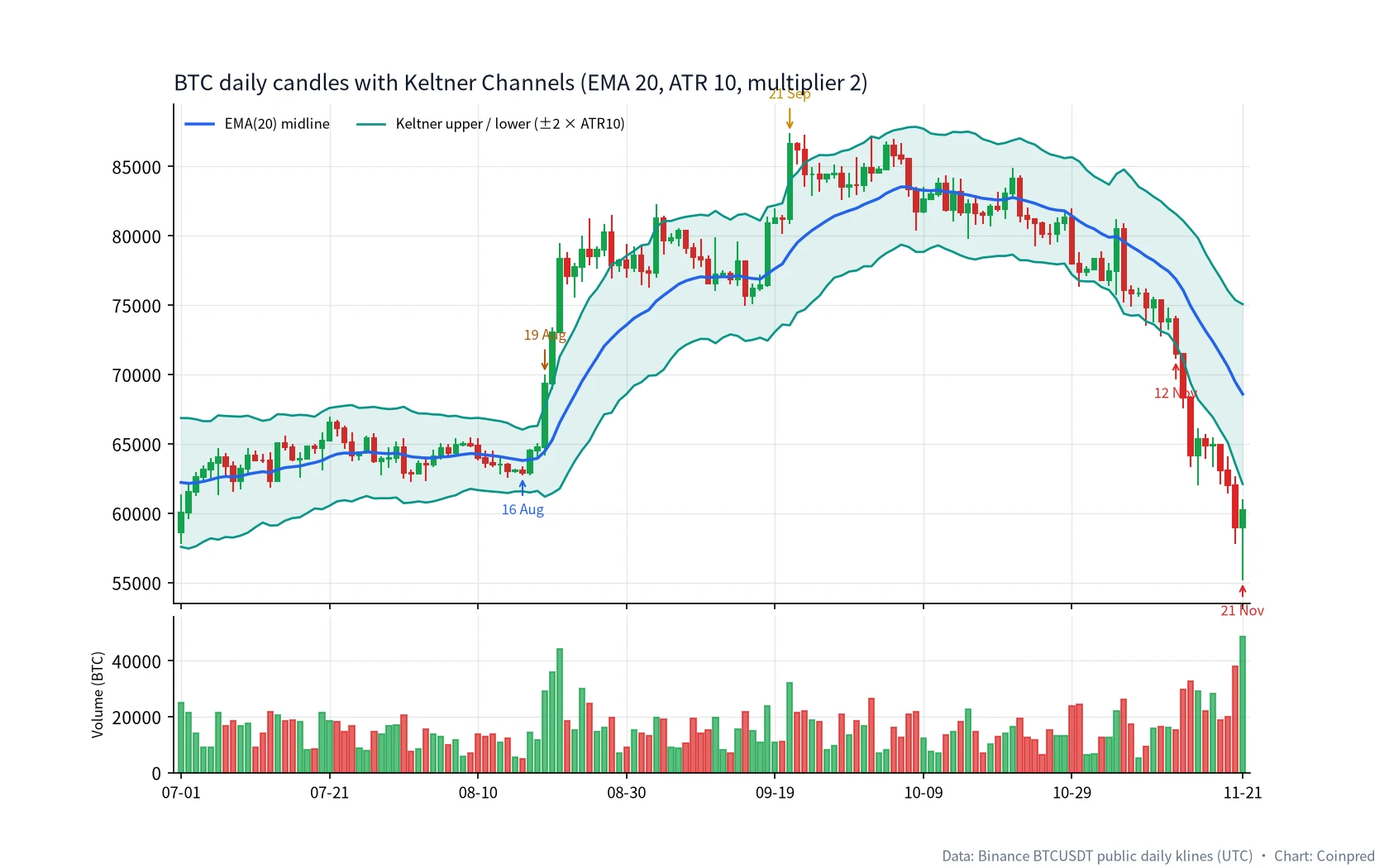
Stocks have an open and a close. Bitcoin does not. It trades 24 hours a day, 365 days a year, so when “today’s daily candle” starts and when it ends depends entirely on which timezone you are using.
When BTC daily candles on different websites or in different software do not match, this is usually why. This article makes the following clear:
- What the UTC time commonly used for Bitcoin price action is, and how it converts to Beijing time.
- When daily and weekly candles start.
- How far apart two daily candles for the same date can be when they are cut in different timezones.
The figures come from OKX’s public API for BTC-USDT, and we take both daily candles cut on UTC and daily candles cut on UTC+8.
1. UTC and Beijing time differ by 8 hours
UTC (Coordinated Universal Time) is the standard time used worldwide. Most crypto data, APIs, and research reports are recorded in UTC. Beijing time is UTC+8: it is 8 hours ahead of UTC, has no daylight saving time, and stays fixed all year.
| UTC | Beijing time |
|---|---|
| 00:00 | 08:00 |
| 08:00 | 16:00 |
| 12:00 | 20:00 |
| 16:00 | 00:00 the next day |
| 23:59 | 07:59 the next day |
One conversion is enough to remember: Beijing time = UTC + 8 hours.
2. When the daily candle starts
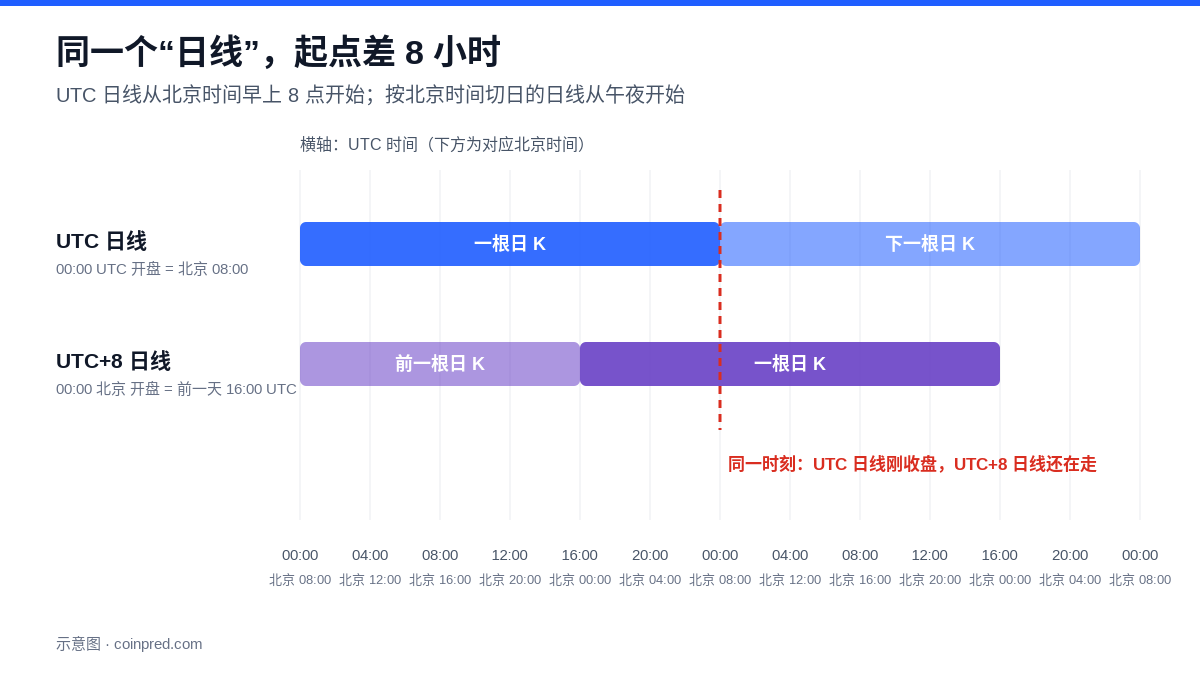
- A daily candle cut on UTC starts at 00:00 UTC, which is 08:00 every morning in Beijing time. So if you are looking at UTC daily candles, 08:00 Beijing time is the moment when “yesterday closes and today opens.”
- A daily candle cut on Beijing time starts at 00:00 Beijing time, which is 16:00 UTC the previous day.
The two cuts are 8 hours apart. At 08:00 Beijing time, the UTC daily candle has just closed, while the Beijing-time daily candle has only run one-third of the way.
Weekly and monthly candles work the same way. On UTC, the weekly candle usually starts at 00:00 UTC on Monday (08:00 Monday morning in Beijing time), and the monthly candle starts at 00:00 UTC on the 1st of the month.
3. How far apart two daily candles for the same date can be
We took the most recent 29 complete days, cut them on UTC and on Beijing time, and compared them day by day:
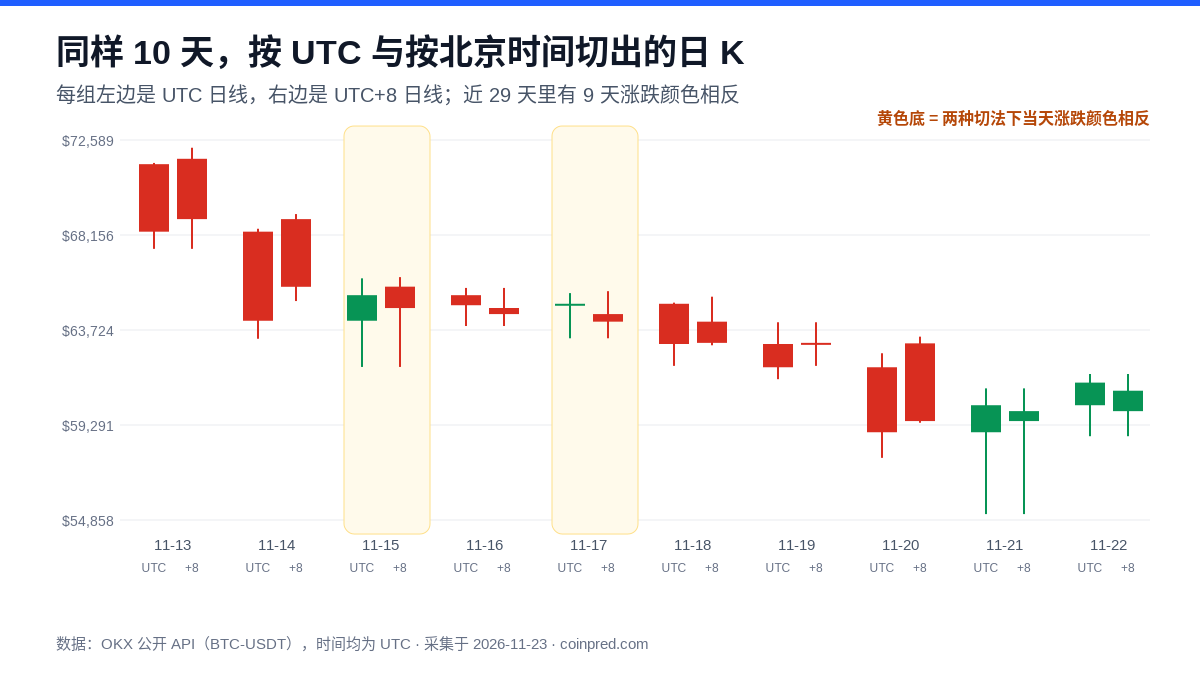
- On 9 of the 29 days, the two cuts had opposite up/down colors: one side was a bullish candle, the other a bearish candle.
- Closes differed by 0.79% on average, or about $470 at $60,000.
A few concrete examples:
| Date | UTC daily (open → close) | Beijing-time daily (open → close) | Difference |
|---|---|---|---|
| 2026-11-15 | 64,156.1 → 65,348.3 (up) | 65,746.1 → 64,747.7 (down) | Opposite colors |
| 2026-11-17 | 64,879.4 → 64,947.8 (up) | 64,466.2 → 64,112.8 (down) | Opposite colors |
| 2026-11-14 | Low 63,315.0 | Low 65,074.0 | Lows differed by $1,759 |
| 2026-11-20 | Close 58,952.7 | Close 59,474.3 | Closes differed by $521 |
That points to a fact that is easy to miss: whether “BTC was up or down on a given day” itself depends on the timezone. The same “15 November daily candle” can be bullish on one person’s chart and bearish on someone else’s.
4. The time on 4-hour and hourly candles
Hourly candles are cut on the hour. UTC and Beijing time differ by a whole 8 hours, so 1-hour candles and shorter are the same bars under both timezones; only the labelled time is different.
4-hour candles are a different story. When they are cut on UTC, each 4-hour candle starts at:
| UTC start | Beijing-time start |
|---|---|
| 00:00 | 08:00 |
| 04:00 | 12:00 |
| 08:00 | 16:00 |
| 12:00 | 20:00 |
| 16:00 | 00:00 the next day |
| 20:00 | 04:00 the next day |
Because 8 is a multiple of 4, 4-hour candles cut on UTC and on Beijing time also line up exactly. The differences show up mainly on daily, weekly, and monthly candles. If a piece of software uses a timezone whose offset from UTC is not a whole-number multiple of 4 (for example, some regions are 5.5 hours off), even the 4-hour candles will not match.
5. Converting a few commonly used times
| Event | Local time | UTC | Beijing time |
|---|---|---|---|
| UTC daily close / open | — | 00:00 | 08:00 |
| US stock-market open (US winter time) | 09:30 Eastern | 14:30 | 22:30 |
| US stock-market open (US daylight time) | 09:30 Eastern | 13:30 | 21:30 |
| US stock-market close (US winter time) | 16:00 Eastern | 21:00 | 05:00 the next day |
The United States usually starts daylight saving time on the second Sunday in March and ends it on the first Sunday in November, so the Beijing time that corresponds to the US cash open changes twice a year. BTC volatility often expands around the US cash open, which is worth watching if you trade intraday.
6. What timezone changes
- Daily candle patterns. Single- or two-candle patterns such as hammers, dojis, and engulfing patterns may no longer hold if you change timezone.
- Indicator values. RSI, MACD, moving averages, and similar indicators are computed from the close. A different daily close time means different indicator values.
- “The day’s return.” The “24-hour change” on a market site is a rolling calculation, while “today’s change” depends on which moment is treated as the open.
- Backtests and reviews. The same strategy backtested on UTC daily candles and on Beijing-time daily candles can produce different results. Confirm the timezone before you reconcile someone else’s data.
- Event settlement. Many perpetual funding rates settle every 8 hours. Common times are 00:00, 08:00, and 16:00 UTC, which is 08:00, 16:00, and 00:00 Beijing time.
7. Practical suggestions
- Standardize on UTC. That stays consistent with global data, research reports, and trading APIs, and is the least error-prone. Daily figures in Coinpred articles are computed on UTC by default.
- Check the timezone setting in your charting software. Most charting tools let you switch timezone in settings or in the lower-right corner. Confirm it before you read the chart.
- Write the timezone down when you review. When you log a trade, write “03:00 UTC” or “11:00 Beijing time,” not just “in the morning.”
- Watch 08:00 Beijing time. If you use UTC daily candles, the period around 08:00 Beijing time is when the daily candle closes and a new one starts, and many daily-level signals confirm then.
To learn how to read a single candle, see How to read crypto candlestick charts; for daily forecasts whose error is measured on a UTC day, see the daily forecast archive; for how to judge direction on an intraday horizon, see How to predict whether Bitcoin goes up or down.
FAQ
At what Beijing time does the Bitcoin daily candle close?
If daily candles are cut on UTC, they close at 00:00 UTC, which is 08:00 every morning in Beijing time. If they are cut on Beijing time, they close at midnight 00:00 Beijing time. Use the timezone setting in the software you actually use.
Is the time on a BTC chart UTC?
Not necessarily. Many data APIs and research reports use UTC, while charting software usually lets the user pick a timezone, and some default to the exchange’s location or to your computer’s local time. Confirm the timezone in settings before you read the chart.
Why does the same day’s BTC daily candle have different colors on different websites?
Because they cut the daily candle in different timezones. Our comparison shows that in the most recent 29 days, 9 days had opposite up/down colors when cut on UTC versus Beijing time, and closes differed by 0.79% on average.
When does the Bitcoin weekly candle start?
On UTC, the weekly candle usually starts at 00:00 UTC on Monday, which is 08:00 Monday morning in Beijing time.
Data and notes
- Source: OKX public API, BTC-USDT spot daily candles, both the UTC cut (1Dutc) and the UTC+8 cut (1D), collected on 2026-11-23.
- The comparison covers the most recent 29 days on which both cuts had already closed completely.
- This article is for learning only and is not investment advice.